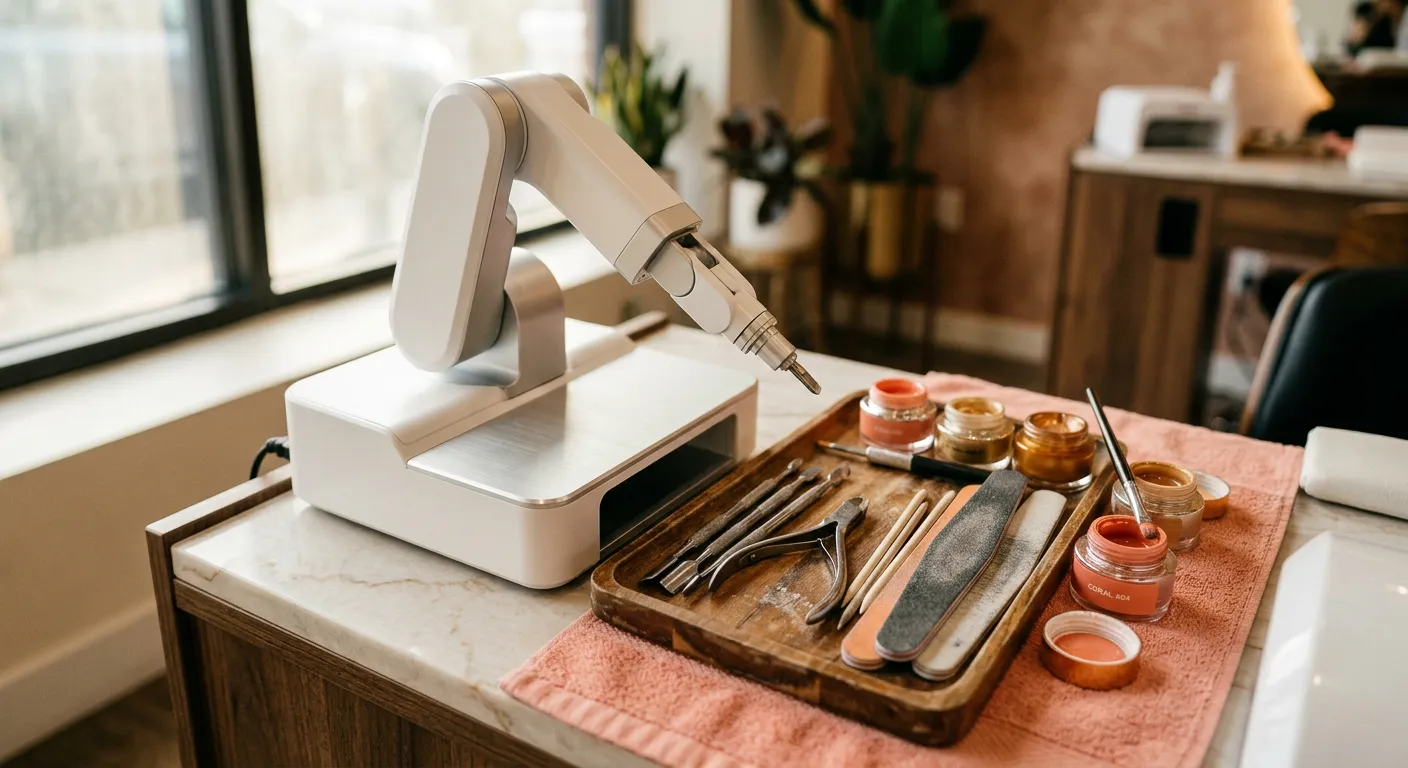
On one side of my table: cuticle nippers I have used for six years, three e-file bits I rotate depending on the client’s nail bed, and a collection of gel polishes arranged by undertone. On the other side of the conversation: a $50 million robot that can file, buff, and paint ten nails in under forty-five minutes without a single human hand involved. This is not a thought experiment anymore. 10Beauty’s robotic manicure machines are already inside Ulta Beauty stores in Massachusetts, with plans for thirty locations by summer 2026. Nordstrom and Walmart are piloting their own beauty robot programs. The question every nail tech I know is asking: should I be worried?
I have been doing nails in LA for eight years. I have watched gel-X kits, press-on brands, and DIY dip powder systems all get called “the end of the salon.” None of them were. But this one feels different, because the machines are not being sold to consumers at home. They are being placed inside the same retail stores where our clients already shop.
What the Robots Actually Do
The 10Beauty machine performs a five-step manicure: polish removal, nail shaping, cuticle grooming with a softening solution and buffing brush, color application, and top coat. Seven precision cameras build a 3D map of each nail. Single-use pods hold all the tools and product, which get recycled after. The whole thing runs twenty-five to forty-five minutes and costs about $30. A licensed manicurist sits nearby during the pilot phase to help guide guests and catch errors.
That is a real service. It is not Clockwork, the earlier robot company that could only paint nails and shut down all twenty-two machines in February 2025 before 10Beauty acquired it. This is closer to what a basic salon manicure looks like, minus the hand massage, minus the conversation, minus the judgment call a tech makes when she sees a nail that is thin on one side and adjusts the file angle without thinking about it.
2019
Clockwork launches first robot nail-painting kiosks in San Francisco
2022
Clockwork expands to Target stores and airports, paints over 500,000 nails
Feb 2025
Clockwork shuts down all 22 machines; 10Beauty acquires the company
Nov 2025
10Beauty launches five-step robotic manicure at Ulta Beauty in Massachusetts
2026
Expansion to 30 Ulta locations planned; Nordstrom and Walmart pilot beauty robots
Where the Machine Wins and Where It Doesn’t
I will be honest about what the robots do well. Consistency. A machine that maps your nail in 3D and applies polish along that map will not have a bad Monday. It will not rush your pinky because the next client is already waiting. For a basic color-and-go manicure, the output is clean. Hygiene is also straightforward: single-use pods mean nothing touches two clients. No autoclaving, no UV sterilization questions, no trust required. For a first-time nail client who has read horror stories about unsanitary salons, that is a real selling point.
But basic color is a narrow slice of what salon clients want. The U.S. nail salon industry hit $25.5 billion in 2026. That number is not built on solid-color express manicures. It is built on nail art, extensions, gel overlays, Russian manicure precision, 3D embellishments, and the hundred micro-decisions a trained tech makes during every appointment. A robot cannot look at your nail shape and suggest almond over coffin because of how your cuticle grows. It cannot adjust pressure when it hits a ridge. It cannot do a chrome finish that requires half-curing at exactly the right second, the kind of technique I wrote about in my piece on chrome pricing.
Robot vs Salon Manicure Comparison
Who Should Actually Pay Attention
If your business is express manicures at a high-volume walk-in salon, priced between $20 and $35, the robots are direct competition. That is the segment 10Beauty is targeting: the client who wants clean nails fast and does not care about the experience. The same client who might already choose press-ons over a salon visit when time is tight.
If your business is nail art, specialty finishes, extensions, or any service that involves sculpting, layering, or creative decision-making, the machines are not in your lane. Not yet. Maybe not for a long time. The Bureau of Labor Statistics projects nail tech employment to grow 7% through 2034, faster than the national average. Demand for skilled hand work is not shrinking.
What I find most interesting is the staffing angle. The beauty industry has real labor gaps. Recruiting and retaining nail techs is a persistent problem, especially for basic services that pay less and burn people out faster. Salon owners I know in LA have had open chairs for months because nobody wants to do $25 gel manicures all day. If a robot handles the express manicures that nobody wants to do, that could free human techs to focus on the higher-ticket, higher-skill work that actually pays well. That is not a threat. That is a restructuring.
There is also a geographic question. The first 10Beauty machines are in Boston suburbs. The expansion plan targets major metros. Rural salons and smaller markets are years away from seeing a robot, if they ever do. If you run a nail salon in a mid-size town, this is interesting dinner conversation, not a business emergency.
My Honest Read
I watched my first 10Beauty demo video the way I imagine a portrait painter watched the first digital camera. There is a moment of vertigo. Then you remember that the camera did not kill painting. It killed cheap portraits. The painters who adapted made more, not less.
The robot is coming for the $30 basic manicure. It is not coming for the $80 sculpted set with hand-painted florals. It is not coming for the client who books with you because she trusts your eye, your technique, your taste. It cannot read a mood, or notice that someone came in quieter than usual and needs twenty minutes where somebody holds their hand and makes them feel put together.
If you are a tech who has been meaning to level up into nail art or specialty services, this is your signal. The floor of the market is about to get automated. The ceiling is still yours.