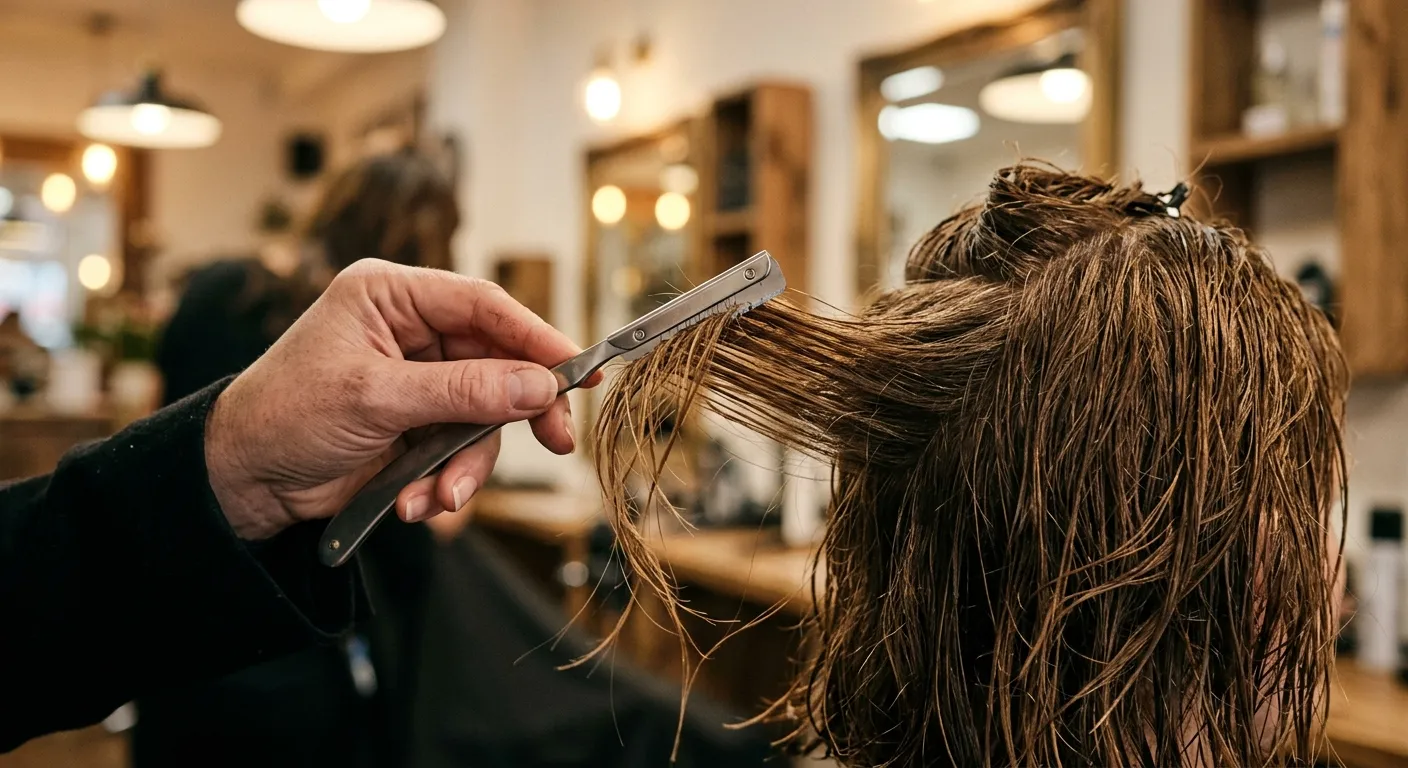
The global hair texturizer product market hit $2.5 billion in 2025 and is projected to grow at 8% annually. That number tells you where client demand is heading before a single trend forecast does. People want texture. They want movement. And the tool that delivers both faster than anything else is the one most stylists put down a decade ago: the razor.
I teach at a cosmetology school in Manhattan three days a week. In 2023, maybe two students per semester asked me to cover razor technique. This spring, I had to add a dedicated razor module because the requests wouldn’t stop. Fourteen out of twenty-two students in my current cohort specifically asked for it.
Something shifted. And it happened faster than I expected.
Why Razor Cutting Disappeared
Razors fell out of favor for practical reasons. The blunt, precise aesthetic dominated the 2010s. Glass bobs. Sharp lines. Clean weight lines you could see from across the room. Scissors and shears did that work better. Razors create soft, tapered ends. That was the opposite of what clients wanted.
Cosmetology programs responded. Razor work got compressed into a single unit, taught fast, tested once. Most new stylists graduated knowing how to hold a feather razor but not how to build a full cut around one. The skill atrophied across an entire generation of professionals.
I watched it happen from the classroom. By 2018, the razor module at my school was a footnote. Students treated it like a licensing requirement, not a real skill. The industry moved on.
Then clients changed their minds. And they changed them fast.
What Brought It Back
Three forces converged between 2023 and 2025.
First, the air-dry movement. Clients stopped wanting hair that looked best 20 minutes after a blowout. They wanted cuts that looked right when they woke up. Razor-cut ends taper naturally. They fall without needing heat or product to behave. Scissor-cut blunt ends do the opposite.
Second, the shag and its descendants. Ghost layers, cloud cuts, modern shags. All of these styles depend on internal texture and weight removal. You can point-cut your way there with shears, but a razor does it in half the passes. My students figured this out before I told them. They watched tutorials, saw the speed, and started asking questions. If you want to understand how ghost layers took over classrooms, the razor is half the story.
Third, low-maintenance became the entire aesthetic, not just a preference. Celebrity stylists started describing the 2026 look as “structured minimalism softened by natural movement.” Razors produce exactly that. Wispy, broken texture that still holds a shape. The tool matches the moment.
2015-2019
Blunt precision dominates. Glass bobs, sharp weight lines, scissor-forward technique. Razor modules shrink in cosmetology programs.
2020-2022
Pandemic accelerates low-maintenance preferences. Shags and curtain bangs rise. Some stylists rediscover razors for texture work.
2023-2024
Air-dry movement goes mainstream. Ghost layers, cloud cuts, and lived-in texture drive demand for internal weight removal. Razor interest climbs in classrooms.
2025-2026
Razor technique becomes a sought-after specialty. Texturizer product market hits $2.5B. Stylists who razor-cut well command premium pricing.
The Skill Gap Is Real
Here is the problem. A decade of underinvestment in razor education left a gap. Most working stylists under 30 learned razor technique as a checkbox, not a craft. The demand arrived before the supply. And the gap is wider than most salon owners realize.
I see this from the chair, too. Three of my regular clients switched to me specifically because their previous stylists couldn’t razor-cut a shag without leaving the ends looking chewed. Bad razor work is obvious. The ends fray instead of taper. The movement looks accidental instead of intentional. It takes serious blade control to get the result clients want.
The textured hair education gap I wrote about last month applies here too. Schools are catching up, but slowly. The stylists who invest in razor technique now have a window where demand outpaces supply.
| Factor | Scissor Cut | Razor Cut |
|---|---|---|
| End texture | Blunt, clean | Tapered, wispy |
| Best for | Precision shapes, bobs, blunt lobs | Shags, layers, lived-in texture |
| Air-dry behavior | Can look heavy or stiff | Falls naturally with movement |
| Skill availability | Universal | Growing gap in stylists under 30 |
| Speed for texture work | Slower (point-cutting) | Faster (slide and carve) |
| Premium pricing potential | Standard | Specialist rates emerging |
What This Means Behind the Chair
If you already razor-cut well, make it visible. Put it on your menu. Film it. Clients are actively searching for stylists who do this work. The specialists I follow on social media are booked weeks out, and they charge $15 to $30 more than their standard cut price.
If you don’t razor-cut, start learning now. Not from a YouTube video. Take a hands-on class. The difference between competent razor work and bad razor work is feel, and feel comes from guided practice with feedback. A feather razor in uncertain hands creates damage, not texture.
For salon owners: this is a training investment worth making. Send one or two stylists to a razor workshop. When they come back, build a dedicated texture-cut service around the skill. Price it separately. Market it specifically. Clients will pay for a stylist who can give them texture that holds without a blowout. They are already proving that with their wallets.
The blunt era is fading. What replaces it requires a different tool and a different education. The stylists who close that gap first will own the texture conversation for years.
I’m still tracking the numbers. My spreadsheet says razor-related student requests tripled in 18 months. The chair data says the same thing. That kind of alignment between what the next generation wants to learn and what clients want to buy is rare. When it happens, pay attention.