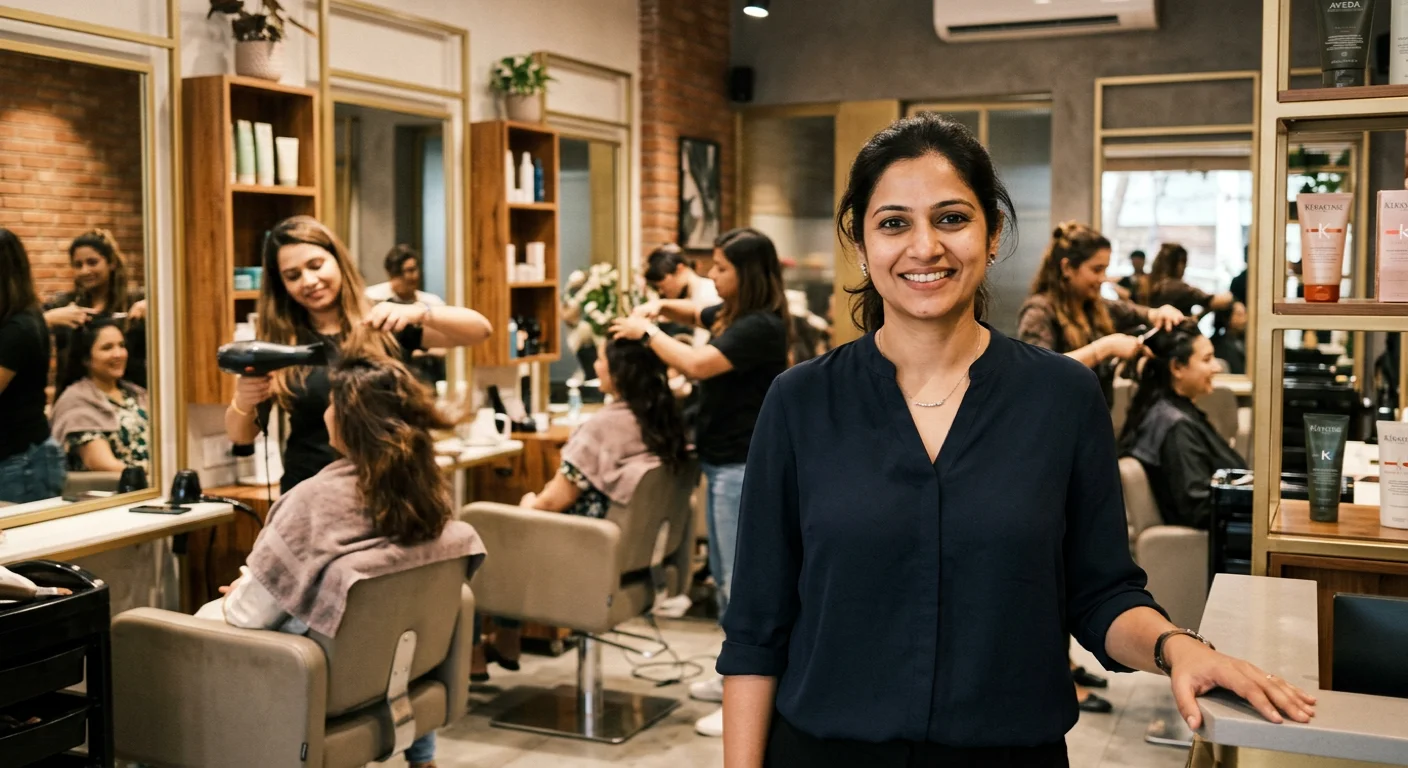
Two years ago I did my last haircut. I remember the client, the color formula, the way she tipped 30% and said “see you in six weeks.” I didn’t tell her there wouldn’t be a next time. I drove home that night and sat in my driveway for ten minutes, because I didn’t know who I was without a pair of shears in my hand.
I want to be direct about something: stopping was the single best decision I have made for my business. My three salons in Dallas-Fort Worth brought in more revenue in the twelve months after I stepped away from the chair than in any previous year. But calling it a “decision” makes it sound cleaner than it was. In reality, the transition took eighteen months of planning, two false starts, and one breakdown in my office with the door closed.
Why salon owners stay behind the chair too long
The math makes it easy to justify. When I was still cutting, I generated about $4,200 a month in personal service revenue. That felt essential. Walking away from $50K a year felt reckless, especially when I was still paying off the buildout for my second location.
But that $4,200 had a cost I kept ignoring. Every hour I spent behind the chair was an hour I did not spend recruiting, training, managing inventory, reviewing financials, or building systems. I was the highest-paid person in the company doing work that any of my stylists could do, while the work that only I could do went undone.
Gallup research on entrepreneurial delegation found that CEOs with strong delegation talent generated 33% more revenue than those who tried to do everything themselves. In salons, the version of “doing everything yourself” is staying behind the chair. We justify it as leading by example. Often we are just avoiding the harder job of leading without the shears.
The timeline of stepping away
I did not go from full book to zero clients in one week. That approach would have tanked morale and left a revenue gap I was not ready to absorb. Instead, I phased it out over about ten months.
Months 1-2: Cut to three days behind the chair
I blocked two days per week as management-only. Used them for one-on-ones, financial reviews, and building the onboarding manual for new hires. My personal revenue dropped to about $2,800/month.
Months 3-5: Down to one day per week
I started transitioning my regulars to other stylists. This was the hardest part. Some clients resisted. A few left. Most stayed when I personally introduced them to their new stylist and stayed in the room for the first appointment.
Months 6-8: New clients only on referral, no rebooking myself
I still filled in when we were short-staffed, but I stopped rebooking my own clients entirely. Every new client who walked in got booked with the team, not with me.
Months 9-10: Full stop
I did my final appointments, cleaned my station, and moved my tools to a drawer in my office. They are still there.
The revenue dip during months three through five was real. My personal production dropped from $4,200 to about $1,100 per month. But by month six, total salon revenue was climbing because I was finally doing the owner work. I fixed a scheduling gap at my Plano location that had been costing us eight open hours per week. I rebuilt our onboarding process so new hires reached full productivity in six weeks instead of twelve. I renegotiated our product supplier contract and saved $6,400 annually.
None of that would have happened if I was still booked back-to-back on Tuesdays and Thursdays.
What made the transition possible
I could not have stepped away without systems. Not motivational poster systems. Actual, documented, repeatable processes that my team could follow without calling me.
The biggest mistake I almost made was trying to hand off my clients without handing off the other responsibilities first. If your team is not ready to operate without you on the floor, pulling yourself off the floor just creates a vacuum. The delegation has to come before the departure.
The identity problem nobody talks about
A Salonspa Connection survey of beauty professionals found that up to 23% of hairdressers feel burned out most of the time, with another 44% experiencing burnout occasionally. For salon owners who also work behind the chair, the burnout is compounded by the dual role. You are exhausted from the physical work and then expected to run a business on whatever energy remains.
I knew all of that. The burnout was obvious. What caught me off guard was the grief.
I built my reputation one client at a time over fourteen years. The relationship between a stylist and a long-term client is real. When I stopped, some of those clients felt like I had abandoned them. One woman who had been with me for nine years sent a message saying she was “disappointed.” That word sat in my chest for weeks.
What helped was redefining what I owed them. I owed them a salon that ran well, stylists who were trained and supported, and an experience that stayed consistent whether I was holding the shears or not. I owed them a business that would still be open in ten years. Staying behind the chair until I burned out was not going to deliver that.
✅ The question that helped me
I asked myself: if I got injured tomorrow and could not cut hair for six months, would my business survive? When I was honest, the answer was barely. That told me everything about how dependent the operation was on my hands instead of my leadership.
Where I am now
My salons did $1.4 million combined last year across 22 employees at three locations. That is the highest annual revenue since I started the business. I spend my days on hiring, training, culture, and strategy. Some weeks I miss the chair. I miss the specific satisfaction of a perfect balayage, the conversation, the tangible proof that I made someone’s day better.
But I traded one kind of impact for another. When I was behind the chair, I could help one client at a time. Now I build the systems and the team that help hundreds. The trade was worth it. The cost was real. Both of those things stay true at the same time.