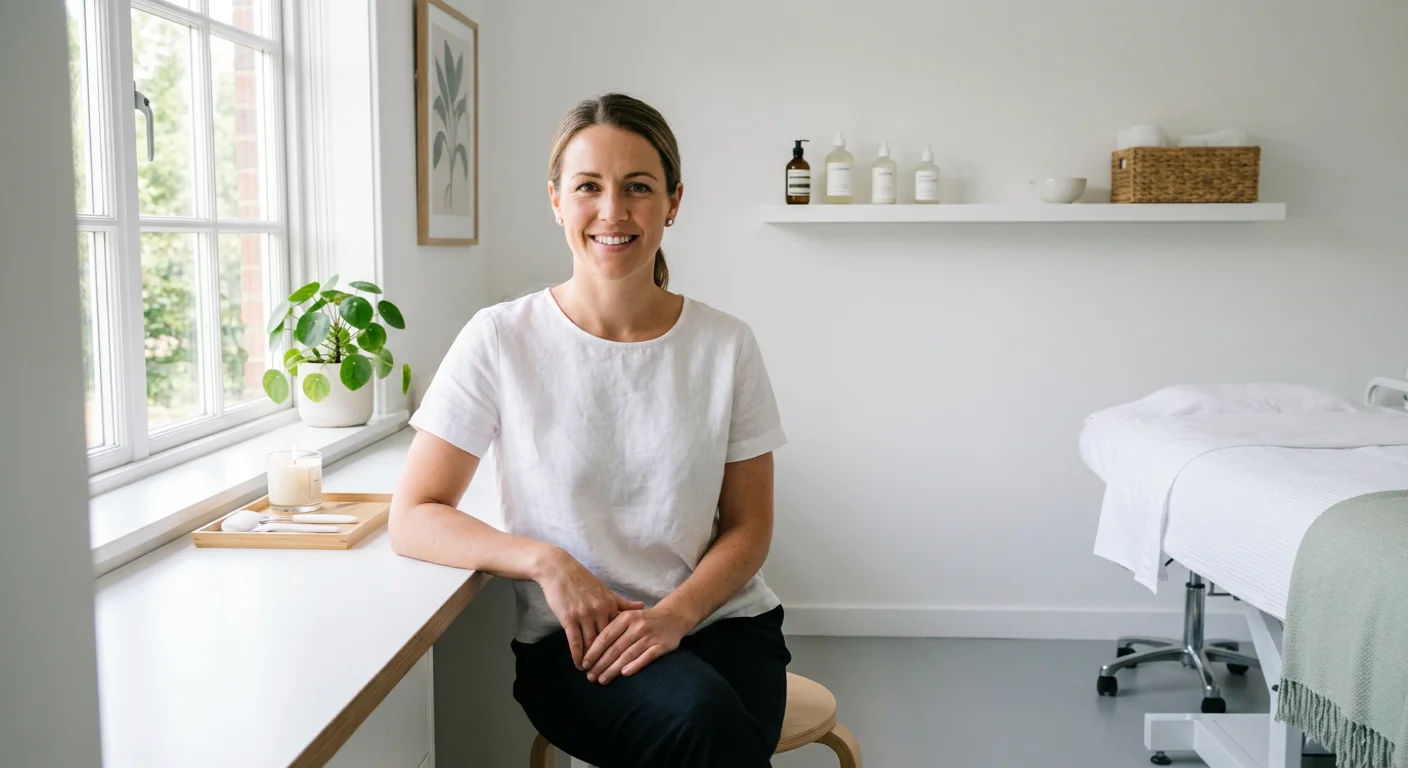
Six months ago I was spending 20 minutes between every client. Not because I was slow at cleaning. Because my room was fighting me. Linens stored across the hall. Products scattered across three shelves with no logic. Trash can behind the door, so I had to walk around the bed to toss cotton rounds. I did this five or six times a day. That is 100 to 120 minutes of wasted movement, every single day, spent on turnover alone.
I was seeing five clients a day at $120 average. I could not fit a sixth because by the time I finished turning over the room, ate a handful of almonds, and checked my phone for the next client’s notes, the gap was gone. Five clients times five days is 25 clients a week. That was my ceiling, and I had been stuck there for two years.
What I Changed in the Room
The fix was not buying new equipment. It was rearranging what I already had.
Moved linens into the room
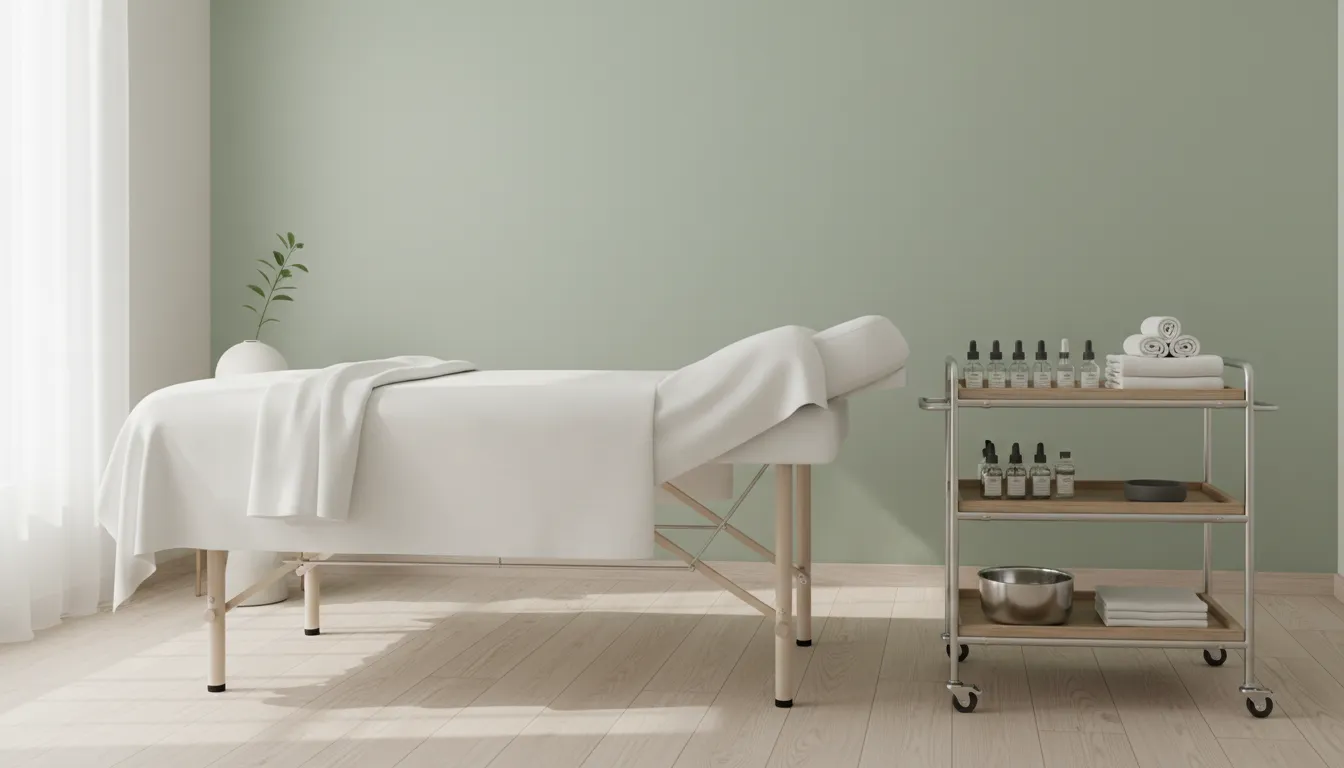
Installed a narrow shelving unit against the wall behind the treatment bed. Stacked 8 sets of folded sheets and towels. No more hallway trips between clients.
Reorganized the trolley by service order
Top shelf: cleanser, toner, gauze, cotton rounds (used first). Middle shelf: treatment serums and masks (used mid-service). Bottom shelf: moisturizer, SPF, disposal bowl. Everything flows top to bottom in the order I use it.
Added a second trash receptacle
Small stainless bin with a foot pedal, mounted on the trolley's side hook. Dirty cotton and gauze go straight in without walking anywhere.
Pre-staged the next client's setup
During the last 5 minutes of each facial (mask sitting time), I lay out the next client's sheet set and products on the lower shelf. When the current client leaves, the room is half-ready before I start cleaning.
Switched to spray disinfectant with 3-minute dwell
Replaced wipe-based disinfecting with a spray that meets EPA standards at a 3-minute contact time. Spray the bed and surfaces, strip the old linens while the disinfectant sits, lay the new set, done.
Total cost: $45 for the shelf unit, $12 for the trolley bin, $9 for the spray bottle. Under $70.
The Numbers Before and After
I tracked turnover time with a stopwatch for two weeks before making changes and two weeks after. Here is what shifted.
| Metric | Result |
|---|---|
| Average turnover time | 20 minutes |
| Clients per day | 5 |
| Weekly revenue (5 days) | $3,000 |
| Steps taken per turnover | 34 (pedometer count) |
| Time lost to searching for products | 3-4 minutes per turnover |
| Metric | Result |
|---|---|
| Average turnover time | 8 minutes |
| Clients per day | 6 |
| Weekly revenue (5 days) | $3,600 |
| Steps taken per turnover | 11 (pedometer count) |
| Time lost to searching for products | 0 |
The extra 12 minutes per turnover, multiplied across five turnovers, gave me a full hour back. That hour became a sixth appointment slot. At $120, that is $600 per week and over $31,000 per year in revenue I was leaving on the table because my trash can was behind the door.
Why Most Turnover Advice Misses the Point
Articles about treatment room efficiency focus on what products to stock or how to decorate. The ASCP recommends 30 minutes between clients when you account for full sanitation protocols. That timeline is correct if your room forces you to walk back and forth, dig through shelves, and make multiple trips.
The problem is movement, not sanitation. I did not cut any cleaning steps. I cut walking. I cut searching. I cut redundant motion. The disinfectant still has its full contact time. The linens are still fresh. The room is still compliant. It just does not require me to leave it.
If your morning setup takes too long, the same principle applies. Proximity beats speed. You do not need to move faster. You need to move less.
Did It Hold?
Six months in. I have not dropped below six clients on any full workday since the second week. My turnover averages 8 to 9 minutes depending on the service. On chemical peel days, it takes 10 because of extra surface cleaning. On basic facial days, I have hit 7.
The only adjustment I made: I added a second shelf unit so I can store 12 sets of linens instead of 8. On a six-client day, 8 was tight. Twelve gives me a full day plus a buffer without doing laundry mid-shift.
If you are running a solo room and your calendar has gaps you cannot explain, time your turnover. The bottleneck might not be demand. It might be the distance between your treatment bed and your clean towels.