A client I have seen for three years put her hands on the towel last week like she was confessing something. “I think I have to stop getting my nails done,” she said. She had been wearing acrylics since college. Her natural nails underneath were the color of skim milk, peeling at the free edge, soft enough to bend under pressure. Two years ago I would have shrugged, soaked her off, and sent her home with cuticle oil and an apology. Last week I reached for a small glass jar of rubber base gel and told her we were trying something different.
She left with thin, glossy, almost invisible nails that flexed slightly when she tapped them on the counter. Two weeks later she came back, still wearing them, no lifting. That conversation has happened three times since with three different clients. Rubber base gel is the quietest tool on my station and it is doing more for retention than anything else I bought this year.
What rubber base gel actually is
The name confuses everyone, including techs. Rubber base is a soak-off gel that sits between regular gel polish and builder gel in viscosity. It cures into a layer that moves with the natural nail plate instead of fighting it. Paola Ponce describes it as soft builder gel in a pot or bottle, designed to add volume and reinforcement without the rigidity of hard gel or the brittleness of a thin polish base. The product has been around for years. What is new is how widely it is now used as the foundation of a structured manicure on natural nails.
The reason it works on damaged nails is mechanical. Hard gels and acrylics are rigid. When the natural nail flexes, which it does constantly, the rigid layer above it cannot follow, so it lifts at the edges or cracks the nail plate beneath. Rubber base does the opposite. It bends with the nail. The Gel Bottle’s prep guide explains that lifting almost always starts where rigidity meets flex, and a flexible base coat is one of the cleanest ways to cut that failure point out of the equation.
How nail techs are using it on natural nails
The technique that has spread fastest in the last six months is what most pros are calling a structured manicure. You prep the nail dry, paint a slip layer of rubber base across the surface, then drop a slightly heavier bead in the center of the nail and flip the hand upside down so gravity pulls the gel into a low apex right over the stress point. Refinery29’s structured manicure breakdown describes the apex as the highest point of the nail, the place where it would otherwise snap, reinforced with the thickest slice of gel.
That is the whole trick. No tips, no extension, no acrylic dust. You are reading the natural nail and adding flex armor exactly where it needs it. Color goes on top if the client wants it. It can also stay sheer. A lot of my clients are choosing sheer right now because it pairs naturally with the milky nail aesthetic that has been on every salon menu since Pantone named Cloud Dancer the 2026 color of the year.
Why this is taking over right now
A few things are happening at once. Clients are nail-literate now. They name their products, they have watched dozens of TikToks about lifting, and they are tired of rebuilding their nails after every acrylic removal. The nail care market is forecast to grow from $27 billion in 2026 to $40 billion by 2034, with structured gel systems leading the line items, not the heavy enhancement categories.
The other shift is education. The structured rubber base technique only works if the tech understands prep, viscosity, and how to read a nail’s flex pattern. That is not knowledge you can fake. It rewards techs who treat the appointment as a problem to diagnose. I have been at this for eight years and I still feel sharper after a day of structured work than after a day of standard color.
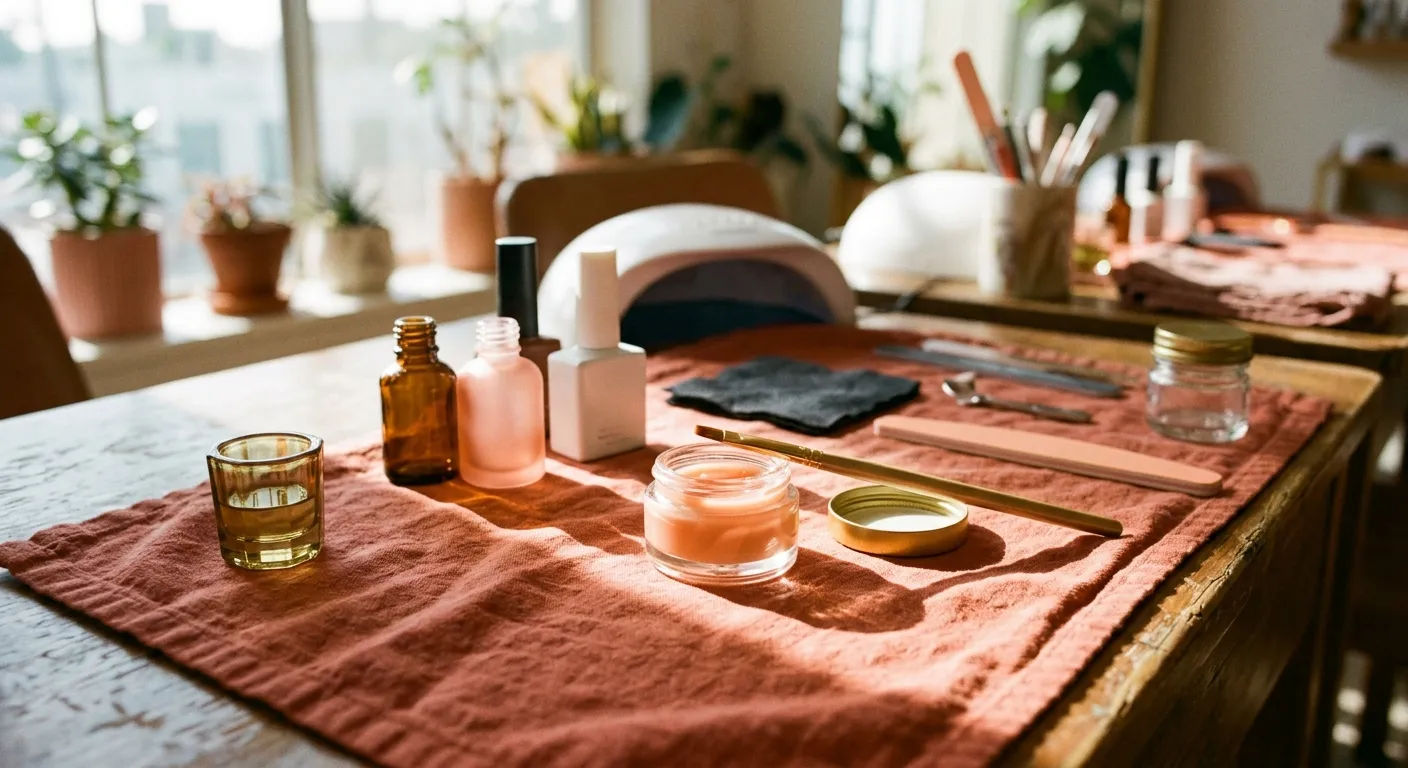
It also pairs naturally with the builder gel category that is replacing acrylics on most pro menus. Builder gel handles the strength side. Rubber base handles the flexibility side. Most techs I know carry both now. Which one comes out of the drawer depends on what is sitting on the towel.
Where the friction shows up
Rubber base does not extend the nail. If a client wants length, you still need tips, forms, or a true builder. It costs more chair time than a basic gel service because the prep and the apex placement both matter. Most techs I know charge fifteen to twenty-five dollars above their standard gel manicure for the structured version. The clients who need it pay without flinching.
Not really. It protects the nail while it grows out, which is what creates the appearance of strength. The nail underneath does not become physically harder. It just stops bending and breaking at the free edge while you wear the structured layer.
BIAB and rubber base overlap in marketing language but they are not always the same product. BIAB is usually a slightly thicker builder in a bottle. Rubber base sits closer to a flexible polish base with body. Some brands use both names for similar products, which is part of why clients arrive confused.
Yes, with a careful prep. You file the loose layers off gently, dehydrate the plate, and apply a very thin slip layer first. The slip layer is the adhesion. The structure goes on top.
What I am watching next
The interesting question is what happens when rubber base becomes mainstream enough that clients ask for it by name. Right now it is a tech-led recommendation. Most of my clients do not know the words. They know they want their nails to look natural, last three weeks, and not destroy what is underneath. When the language catches up to the practice, pricing will have to as well. Salons that figure out how to charge for the diagnosis, not just the application, will hold the better margins.
I am keeping the small jar on my station and watching how my repeat rate moves. Three clients in one month came back specifically because their natural nails were finally growing. That is not a number I usually associate with a polish category. It feels like the start of something.